Jonathan Harris’ I Love Your Work (2013) is an interactive documentary environment that depicts “the realties of those who make fantasies.” Alternately referred to by its creator as a film and a portrait, the piece collates fragments of the private quotidian lives of nine women who make lesbian pornography. Harris follows each woman for one full day of a consecutive ten-day shooting schedule (one is featured twice), capturing one ten-second video clip every five minutes to create a six-hour timeline of 2,202 total clips. The navigable environment is freely previewable, but costs ten dollars per twenty-four hours of access and is limited to ten scheduled views per day, evoking the exclusivity and expense of premium online porn sites (a premium package is also available for just three hundred). Harris intentionally limits his clips to ten seconds to invoke the format of free teasers that elicit payment from horny surfers, claiming that these “fractured windows … are partially teasers for porn, but primarily teasers for life.” What follows is an innovative and potentially problematic incursion into the privacy of those who make it their commercial business to make public that which is most intimate.

I Love Your Work is a new media artifact, and due to its countless possible permutations, the piece can never be read the same way twice, or perhaps more appropriately engaged with or participated in twice. Its interface constitutes both an amalgam of the ten concurrent timelines and a rhizomatic tapestry of moments, each of which displays a timecode and the name of its subject. The possibility of conventional formalist textual analysis or close reading is dubious, for in the case of interactive documentary, “Interface is content” (Rose 208). Thus I will attempt to bring my exploration of the material and its database into constellation with two disparate fields of scholarship: feminist approaches (and lesbian reactions to feminist approaches) to lesbian pornography and (fairly new) theoretic analyses of interactive and web documentary practice and spectatorship. It is important here not to consider the emergent interactive documentary mode as an innately new, novel, digital evolution of the form, but as “a form of nonfiction narrative that uses action and choice, immersion and enacted perception as ways to construct the real, rather than to represent it” (Aston and Gaudenzi 125). The contested possibility of multi- or nonlinear narratives is significant here, and we will return to it later.
A number of complexities and potential problematics arise, for I am dealing with a male-authored text that presents the female body both in the context of private life (cf. scopophilia and voyeurism in dominant cinema) and erotic lesbian imagery (so often appropriated or exploited in mainstream porn for the heterosexual male gaze). What can it mean that I Love Your Work shares in so many ways a point of access, however reflexively, with cyberporn? Does limited voyeurism (thanks to the ten-seconds-every-five-minutes model) actually succeed in interrupting or interrogating scopophilic pleasure? How do scrubbing the image and toggling between coincident timelines reflect the actual ephemeral experience of online porn consumption? To what extent can the pleasure of the performer subversively preclude the pleasure of the hidden onlooker? And whose gaze is solicited in mainstream heterosexual porn versus in mainstream woman/woman porn versus in feminist lesbian porn versus in the documentation of the making of feminist lesbian porn? I hope to answer many of these questions as we go along.
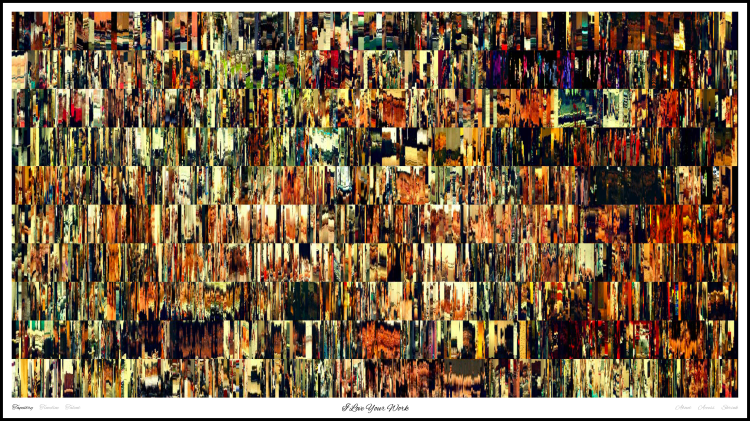
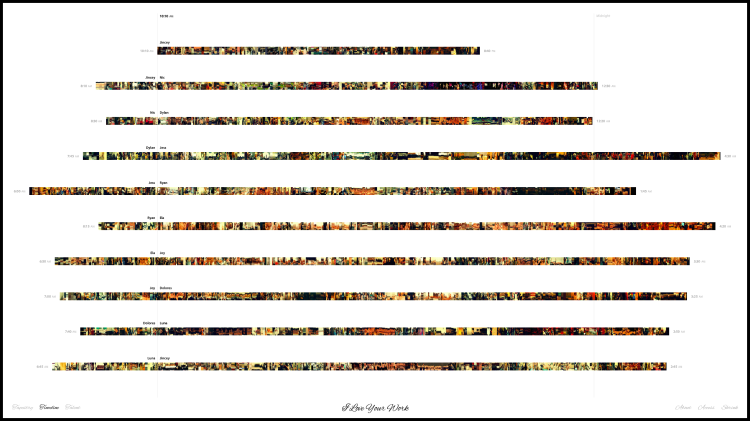
In I Love Your Work, the viewser (a popular portmanteau intended to replace the cinematic spectator in the field of new media) participates in the construction of the construction of sexual fantasy. The interface is a mosaic of filmed moments, shot and organized linearly, but nonlinearly navigable, effectively allowing its viewser to edit her/his own narrative to taste. We are enabled by the precise, mathematic infrastructure to select and reorganize clips at will, which calls into question the filmic notion of a finished product and refuses the mastery over the image permitted by traditional montage. As the architecture dictates, all clips must end at ten seconds; such truncation disavows the duration needed to gain spectatorial purchase on a character or story, to be sutured into a scene. Time itself is distilled and synthesized, and the sheer number of moments that take place in transit (cab, sidewalk, subway) makes us consider how our own time is allocated in urban life. The experience is rhizomatic (Deleuze and Guattari) in the sense that the interface provides interminable and nonhierarchic points of entry and exit and truly infinite navigability between these points, but also because all nine women know or know of each other and exist within a shared community of lesbian porn makers. Beyond the day Harris spends with each of them, many reappear on other days, most often in the context of sex work. Indeed, eight of them are involved, as performers or facilitators, in the production of a ten-part self-pleasure series by Juicy Pink Box Productions called Therapy (Jincey Lumpkin, 2010).
Much of the critical scholarship on lesbian and woman/woman pornography is couched in the mid-eighties feminist sex wars we discussed at length in week ten. Useful to us is Deborah Swedberg’s concept of an oppositional or resistant lesbian pornographic gaze. She suggests that the lesbian consumer of heterosexual male depictions of lesbian sex can in fact reappropriate and reclaim pornographic images of women without sacrificing her pleasure or subjectivity:
Neither appropriation of nor pleasure in explicit sexual images of women is the exclusive province of the heterosexual male gaze. Hence, the lesbian viewer can appropriate the images right back for her own use and pleasure … The structure of sexual representation is destabilized when the gaze shifts from that of a heterosexual man watching a porn movie featuring sex between women to that of a lesbian. As her sexual pleasure is foregrounded, unlike in other contexts, a lesbian may easily fill in the gaps in intelligibility (Swedberg 605, 7).
Cherry Smyth similarly attempts to realign pornographic analysis to account for a lesbian gaze and to reclaim lesbian filmic desire as an act of assertion and self-representation. She also addresses the significant and subversive absence of the money shot in lesbian porn:
the female actor can only signify her pleasure by sound and gesture. Heterosexual porn attempts, but never succeeds, to reveal the mystery of female pleasure which remains hidden … Coming, unlike in much heterosexual and gay male porn, does not immediately signal the end of the sexual act and thus the video. This openness challenges the values of dominant cinematic structures which insist on narrative resolution (Smyth 156).
I find that the interactive and antipoetic (Aristotle) architecture of I Love Your Work reflects this endlessness native to lesbian porn; there is potentially no end to the film, just as there need be no end to the acts of lesbian sex depicted and discussed in the film. Terralee Bensinger traces a shift from spectator to community in process as collective fantasy (cf. the Juicy Pink Box community) and demonstrates how a reframing of pro-sex lesbian pornographic activity can disrupt hegemonic representational practices, but most importantly for us:
Redefining community as lesbian pornographic activity promotes a displacement into the realm of ‘elsewhere’ (which, according to de Lauretis, exists within and not outside hegemonic structures of representation) … Such spaces are likely to be located at the margins of already existent culture, appearing as gaps or interstices within the dominant representational formations … These (no)places are what de Lauretis speaks of as the ‘elsewhere of discourse here and now, the blind spots, or the space-off, of its representations’ (26), and it is here that the feminist subject, now figured from a lesbian nuanced perspective, can begin to move more freely … onto a pro-sex lesbian scene of desire within which traditional pornographic ‘ways of seeing’ can begin to be deconstructed and transfigured through displacement and re-vision (Bensinger 72, 77–8).
In my view, I Love Your Work takes place in and renders partially visible this interstitial realm of elsewhere, this no/place scene of lesbian desire, and recalls concepts of speaking nearby (Trinh), the gaps re/presented in and by Akerman’s and Hatoum’s works, the idea of radical incommensurability in Steryl’s oeuvre, the what if/what is dialectic of Clarke, Jill Johnston’s disruptive evolution of language, Kirchenbauer’s return of the gaze, even Deleuze and Guattari’s notion of minor literatures as operative in and resistant via dominant structures. As Joy, a production assistant and stylist on the set of the Therapy series, suggests, “Well, I guess neverland just, you know, doesn’t exist, so, you can make your own.” Harris’ film solicits us, through interactivity, to construct our own neverland from the fragments available in Lauretis’ displaced realm of elsewhere.

Two powerful lesbian images pervade I Love Your Work and so deserve a brief aside. For Heather Butler the butch, as “the visible marker of lesbianism,” proffers maximum visibility and destabilizes dualist conceptions of gender, overthrowing heterohegemony in the process: “She is the certificate of authenticity in lesbian pornography for lesbians; she turns the screen into a potentially safe space for the visual representation of lesbian desire; and she inspires trust in her lesbian viewers;” in conjunction with the femme, she “can provide us with new ways of viewing pornography” (Butler 169). Two of the women in I Love Your Work identify as dykes or babydykes, and their presence both in the film and in the film within the film establish authenticity because they constitute a threat to the male porn spectator; by emulating him, they resist being sexually consumed by him. The second image is that of the dildo, which for Butler importantly “functions as a pleasure-giver, not a pleasure-seeker;” it doesn’t come, stays hard and is detachable, displacing dominant Lacanian ideas of phallic power: “the phallus does indeed belong to any and everyone … [it] is not the penis, but, rather, a detachable, performative, even phantasmic object that nobody owns and that everybody can play with, wear, or discard” (Butler 183). The strap-on in particular provides a kind of agency to its wearer and can, for Smyth, “subvert the potency of the penis by reasserting women’s sexual sufficiency and proving that the woman lover is more powerful than any male rival … [it] signifies the lack of fixity of gender … Women control the phallus as never before” (Smyth 157). As dyke actor and educator Nic puts it, “sometimes you just want a cock,” but such a desire in no way necessitates having a man.

As an interactive environment, I Love Your Work constitutes what Gaudenzi calls a living documentary, a relational entity based on the dynamic relationships that form between user, author and code via a human-computer interface and its attendant ecosystem. By her logic, Harris’ film is an adaptive, autopoietic assemblage of interdependent elements. As users, we are “internal to the system. It is not one object … but a cloud of possibilities that depends on the possible relations between several dynamic systems: a user, an interactive structure, a database of content and a technical and cultural context” (Gaudenzi 90). I Love Your Work also deploys what Marsha Kinder terms database narrative structure, exposing “the dual processes of selection and combination that lie at the heart of all stories and are crucial to language” and revealing “the arbitrariness of the choices made and thereby challeng[ing] the notion of master narratives whose selections are traditionally made to seem natural or inevitable” (Kinder 349). The ruptured images intrinsic to I Love Your Work carry a subversive potential: they expose the normally hidden architecture of the database and enable us to see (and indeed operate) the narrative engine. For Kinder, “the process of retrieval necessarily involves ideology and desire: where are we permitted to look and what do we hope to find;” such questions are tellingly applicable to the experience of seeking databased porn online.
For Adrian Miles, faceted, granular, multilinear works like Harris’ have crystalline structures that irrevocably alter the role of the filmmaker: s/he no longer determines fixed relations between shots through editing, but rather assembles sets of possible relations that will be uniquely realized as permutational sequences by the user in conversation with the interface (clouds, not trees). Miles posits that “[w]hile interactivity, broadly conceived, is often regarded as the addition of complexity and choice to what we make and how we view it, it is in fact best considered a reduction, a choreography of the radically open of the virtual and the crystalline through the reducing interest of decision … reducing the set of all that could be to what is” (Miles 76–7). Finally, Sally J. McMillan acknowledges the extent to which “interactivity may be in the eye of the beholder,” a sentiment that sounds suspiciously like the old “I know it when I see it” rationale for recognizing and categorizing obscenity and porn without clear parameters (McMillan 165).
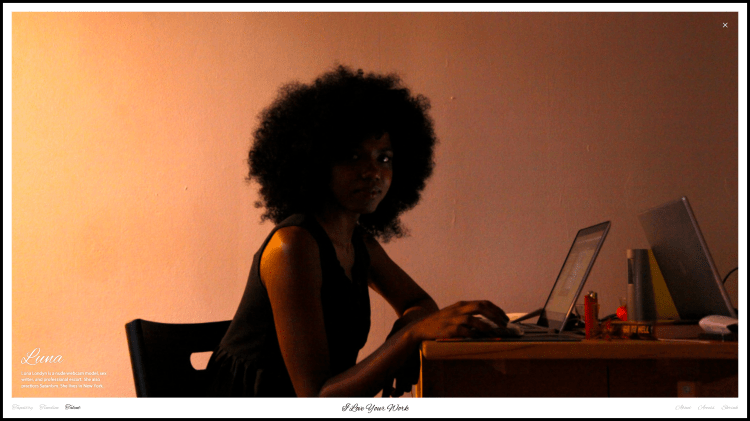
So what does it all mean? I think that by rendering limitedly visible de Lauretis’ realm of elsewhere, her no/places and blind spots of re/presentation, and Butler’s potentially safe lesbian screen space, Harris succeeds in effacing the stigma that surrounds lesbian pornographic production without falling prey to the exploitative capacity of (some) traditional nonfiction filmmaking, providing us with the tools to fashion our own elsewhere neverland and consequently placing on us the onus of exploitation and re/presentation. Elizabeth Cowie observes that documentary film aligns our scopophilic and epistemophilic drives, “a curiosity to know satisfied through sight … What is involved is the wish to see what cannot normally be seen, that is, what is normally hidden from sight.” Harris’ film betrays forbidden images, but its ruptured multilinearity precludes voyeuristic pleasure. The act of navigating and interacting with I Love Your Work achieves in its viewser an embodied hyperawareness of her/his gaze and choices, productively subverting the traditional safety of pornographic spectatorship via the complicity involved in constructing a narrative and the juxtaposition of extreme erotica with the quotidian experience of city dwelling and work. It is an exposé bereft of damaging exposure.
As to the ever-troubling question surrounding the male authorship of I Love Your Work, it appears not to matter as much as I anticipated, or perhaps intended, for two reasons: first, the women featured traffic in exhibitionism, even exploitation by the camera’s gaze on a daily basis, as we can so clearly see in the film. They are as unfazed by Harris’ gaze in their domestic spaces, even less so (Jess), as they are by those of their various shoots (Luna). Second, as we learn from Swedberg, the authorship of lesbian pornography, whether male (woman/woman) or female, is privy to the same contradictions of gender and power regardless of authorial intent due to the fact that dominant pornography is always already such a highly codified mode (e.g. butch as unintentionally endorsing the gender binary). Like documentary in some ways, porn is up to the beholder to assign, interpret and/or appropriate meaning.

Finally, what is at stake in my attempt to constellate the fields of interactive documentary and lesbian porn? I think porn can be fruitfully thought of as a predigital interactive mode of image-making and consumption, and in its current networked iterations, according to Harris himself, “It is the staging ground for almost every new digital technology … Porn is the elephant in the room of the Internet.” The spectator is interpellated in a much more signifiant, dare I say embodied, way than in mainstream film practice and is engaged by a medium intended for arousal, self-pleasure and masturbation. Linearity is present in porn, but matters less than in other modes, if at all, for the rhizomatic, archival and databased structure of access to online porn in the digital age already involves toggling between clips, fragments and segments, finding one or several that generate the appropriate desired response in the viewser’s body. Scrubbing the image to locate the money shot and assembling compilations of affective moments are part and parcel of the contemporary porn consumer’s experience of spectatorship. Indeed, porn flicks tend to end not when the narrative or the experiment reaches completion, but when the user does, finishes up, achieves what s/he came to do. I Love Your Work reflects and critiques this pleasurable relation to the image, and succeeds in exposing the apparatus, refusing a fixed spectator position, denying (at least displacing) pleasure and mixing documentary and fiction (Kaplan). It interrogates film language, practice and the depiction of reality, and I think deserves recognition as an innovative instance of Johnston’s counter-cinema.
Works cited
Aston, Judith and Sandra Gaudenzi. 2012. “Interactive documentary: setting the field.” Studies in Documentary Film vol. 6, no 2.
Bensinger, Terralee. 1992. “Lesbian Pornography: The Re/making of (a) Community.” Discourse vol. 15, no. 1.
Butler, Heather. 2004. “What Do You Call a Lesbian with Long Fingers? The Development of Lesbian and Dyke Pornography.” In Porn Studies, edited by Linda Williams. Durham: Duke University Press.
Cowie, Elizabeth. 1997. “The Spectacle of Reality and Documentary Film.” Documentary Box no. 10.
Gaudenzi, Sandra. 2013. “The Living Documentary: from representing reality to co-creating reality in digital interactive documentary.” PhD diss., Goldsmiths, University of London.
I Love Your Work. 2013. Jonathan Harris.
Kinder, Marsha. 2003. “Designing a Database Cinema.” In Future Cinema: The Cinematic Imaginary after Film, edited by Jeffrey Shaw and Peter Weibel. Cambridge: The MIT Press.
McMillan, Sally J. 2002. “Exploring Models of Interactivity from Multiple Research Traditions: Users, Documents and Systems.” In Handbook of New Media: Social Shaping and Consequences of ICTs, edited by Leah A. Lievrouw and Sonia Livingstone. London: SAGE Publications.
Miles, Adrian. 2014. “Interactive Documentary and Affective Ecologies.” In New Documentary Ecologies: Emerging Platforms, Practices and Discourses, edited by Kate Nash, Craig Hight and Catherine Summerhayes. Basingstoke: Palsgrave Macmillan.
Rose, Mandy. 2014. “Making Publics: Documentary as Do-It-with-Others Citizenship.” In DIY Citizenship: Critical Making and Social Media, edited by Matt Ratto and Megan Boler. Cambridge: The MIT Press.
Smyth, Cherry. 1990. “The Pleasure Threshold: Looking at Lesbian Pornography on Film.” Feminist Review no. 34.
Swedberg, Deborah. 1989. “What Do We See When We See Woman/Woman Sex in Pornographic Movies?” NWSA Journal vol. 1, no. 4.
 Jasper Lauderdale