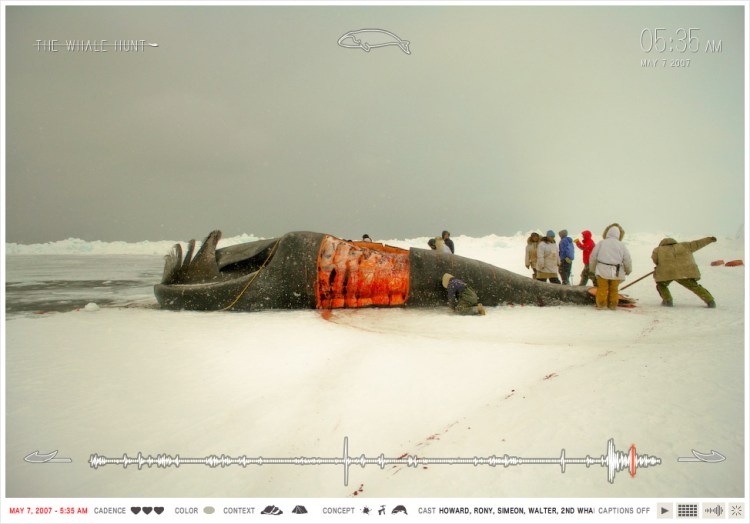
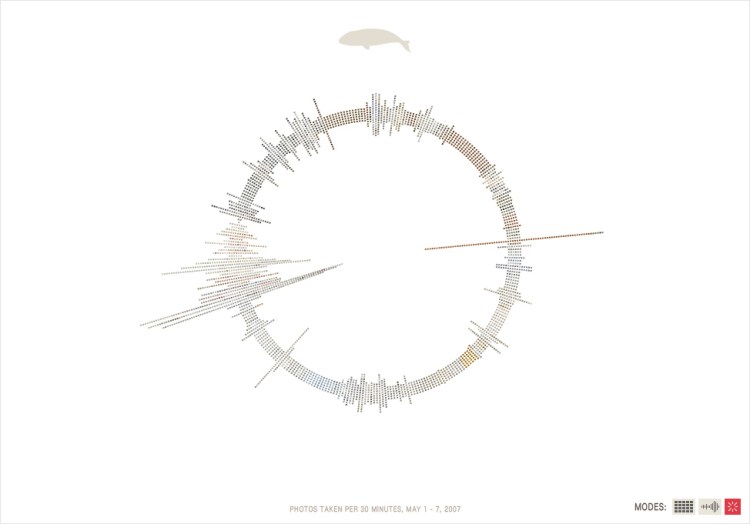
Jonathan Harris’ The Whale Hunt (2007) is an experimental, interactive storytelling environment, shot over the course of nine days Harris spent with a family of Alaskan Inupiat before and during a whale hunt. In terms of its innovative strategies and the filmmaker/subject relation, it resembles another, much earlier, white American male’s documentation of an indigenous north American people’s “quest for survival”—the walrus hunt in Nanook of the North (Robert Flaherty, 1922). It consists of 3,214 photographs, rigorously captured at five-minute intervals, which for Harris establishes a “photographic heartbeat” that at times quickens to mimic the filmmaker’s own. Whale Hunt‘s interface is a mosaic of these photographs (which anticipates Harris’ later use of a digital tapestry to organize video), organized linearly, but multiply and nonlinearly navigable, effectively allowing its viewser to edit her own narrative to taste. We are enabled by the precise, mathematic infrastructure to select and reorganize shots at will, which calls into question the filmic notion of a finished product and refuses the mastery over the image permitted by traditional montage. The experience is rhizomatic (Deleuze and Guattari) in the sense that the interface provides interminable and nonhierarchic points of entry and exit and truly infinite navigability between these points. Available via the framework are three visualization modes: mosaic, timeline (similarly navigable but framed in a way that evokes a heartbeat monitor) and pinwheel (which suggests the infinite repeatability of the narrative), each with selectable constraints (filters) including cast, concept, context and cadence.
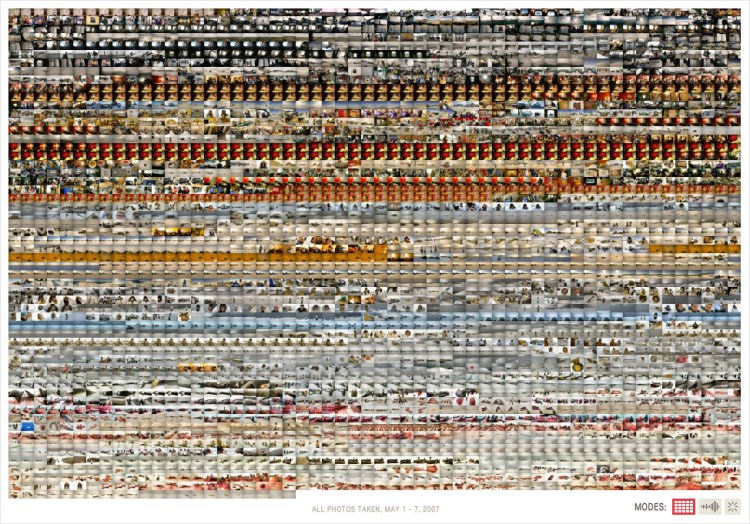
Harris’ work deploys what Marsha Kinder terms database narrative structure, exposing “the dual processes of selection and combination that lie at the heart of all stories and are crucial to language” and revealing “the arbitrariness of the choices made and thereby challeng[ing] the notion of master narratives whose selections are traditionally made to seem natural or inevitable” (Kinder 349). The ruptured, repetitive images intrinsic to Whale Hunt carry a subversive potential: they expose the normally hidden architecture of the database and enable us to see (and indeed operate) the narrative engine, though it is of course possible for such an interactive experience to “detract from narrative engagement. Beattie (2008, p. 45) suggests this when she describes the process of engaging with interactive documentary as an alternation between immersion in narrative and the ‘periodic reappearance of the ‘machinery’” (Nash 58).
 Jasper Lauderdale