As commonly attends the arrival of a nascent art form, the field of scholarship that surrounds the emergent interactive documentary mode is as yet highly contested, replete with suggested, sometimes limiting definitions and aspirational, perhaps totalizing taxonomies, mired in familiar questions of medium-specific features and properties and the dialectics of content and form. Indeed, McMillan has proposed that “interactivity may be in the eye of the beholder,” (2002, 165). But whatever new modalities of interaction bring to the table, whether they lay in the eye or the hand of the beholder, we must be wary of acclaiming the newness and novelty of interactive documentary when investigating or evaluating its artistic and political implications as an innovative digital approach to factual representation, “a form of nonfiction narrative that uses action and choice, immersion and enacted perception as ways to construct the real, rather than to represent it” (Aston and Gaudenzi 2012, 125).
I argue that the interactive documentary mode can provide its viewser with alternate means of engaging with nonfiction film content and accompanying paratextual material. Such projects can serve to illume realities of gendered violence performed by or acted upon multiply marginalized women in the alleged third world. More significantly I address the potential of such works to function as mobilizing, provocative calls to activism, advocacy and restorative social justice, and the concomitant potential for the viewser to become an interactant both within and (hopefully) beyond the texts. My selection of “films” should be seen as an assemblage of discrete cases grounded in and linked by their common distance from digital mediation and bound by the mass, often state-sanctioned silencing of illiterate, impoverished and/or female voices.
Exploring the potential of such interactive works to increase active awareness and even to motivate political activity should help to enlighten us as to how the user complicity so intrinsic to interactive cinema can complicate and advance the aims of conventional socially oriented documentary practice. I hope to demonstrate that the dawning interactive documentary film does indeed afford new agency to its viewser and in so doing supplies her with new processes for participation in constructing reality. Pertinent here is the empathic capacity of interactivity to enable viewsers to experience their worlds through contradictory perspectives. Interactive filmmaker Kel O’Neill suggests that because “there is no one right perspective on the world … it’s incumbent upon creators to offer audiences the ability to experience and navigate between multiple perspectives in a single work. And that’s where interactive work really soars … and outperforms more established mediums. Every great piece of interactive work is an experiment in empathy.”
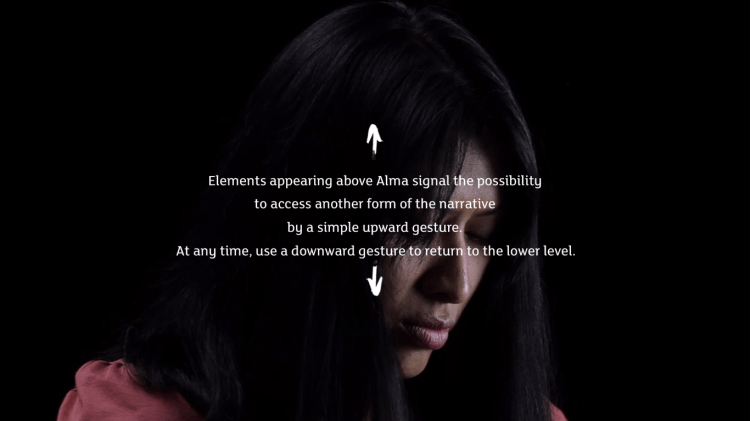
I proceed by the level of sociopolitical efficacy activated and enabled by divers modalities of interaction in each of four cases. First is Alma: A Tale of Violence (2012), a hermetic take on the interactive documentary format that renders visible its eponym’s memories of being engaged in and subjected to extreme violence as a marero in a Guatemalan street gang. She gives testimony via conventional direct address in the wake of a failed execution attempt that left her unable to walk and in search of forgiveness and redemption. Alma constitutes a transmedia webdoc that uses the Internet as a broadcast and distribution platform and offers us only very limited navigation of its interface and within its otherwise linear narrative structure. The film proceeds sequentially, but incorporates a multidirectional interface not unlike that of a nonlinear editing system, in which discrete video tracks are organized spatially and vertically such that the viewser can toggle between them. Alma’s confession is coupled with animation, photographs, video reenactments and b-roll footage on the upper track, but her affective closeup is continuously available on the lower and it serves to guide us through her experience of “killing to be loved,” of being beaten to belong.
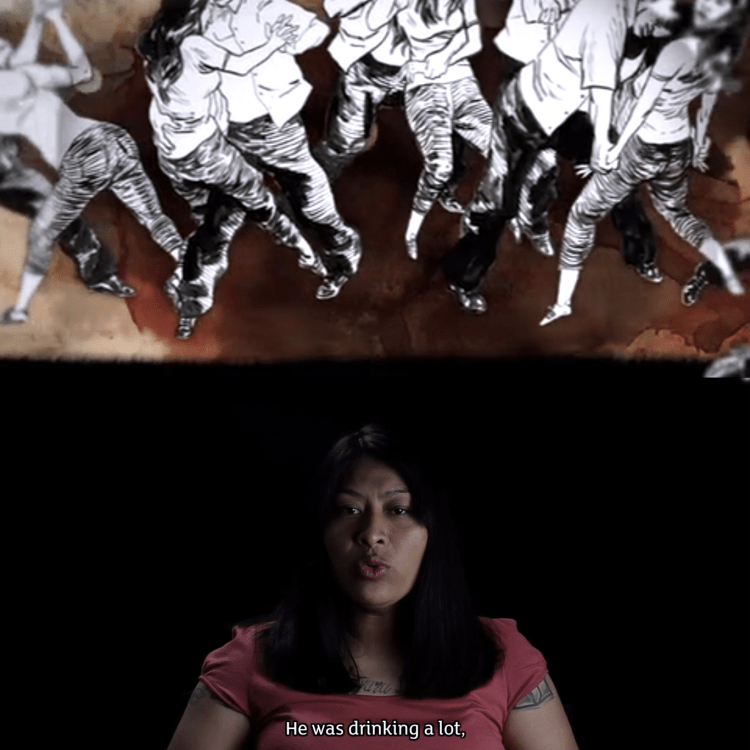
While Alma lacks the participatory possibilities of many more interactive documentaries, its singular form employs Gaudenzi’s notions of co-initiated and subject-generated content. Collaboration occurs in the preproduction phase and borrows from the socially activist and participative school of cinéma vérité. Alma is thus “a character who can use digital media to empower [herself] … and maybe change [her life]” (Gaudenzi 2014, 141). Here the digital artifact’s user occupies a position of limited interactivity when navigating, but its paratextual content provides other interesting opportunities for critical awareness of the issues depicted. Alma’s narrative is distributed across multiple platforms and includes four video modules, an open-source webcast, a forum, a free tablet app, a noninteractive broadcast version and two books, broadening Alma’s archive of violent memories.
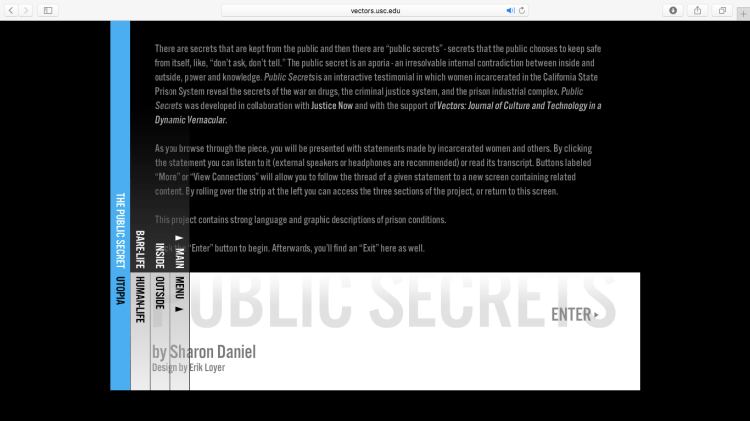
Public Secrets (2008) also presents nonfiction, though exclusively aural, content in a bid to raise public awareness of social injustices. It features the testimonies of incarcerated women revealing the “public secrets” of the criminal justice system, prison-industrial complex and war on drugs. Secrets offers a far more interactive interface than does Alma, but similarly uses collaborative, co-initiated and subject-generated content, supplying tools that induce intensely marginal others to speak for themselves and, perhaps more importantly, to be heard, to assert their political subjectivity.
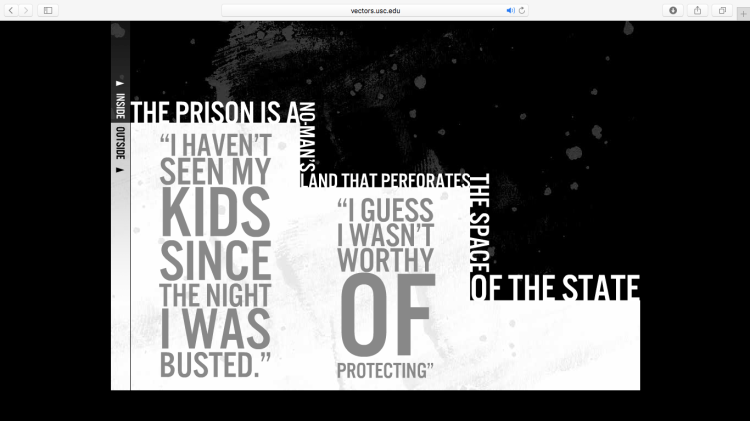
Secrets comprises about five hundred statements, recorded and databased over a period of six years. Typed passages appear and disappear, to be replaced by others in a spatially organized mosaic of words. Selecting one plays its corresponding statement in full, and clicking “more” or “view connections” allows the viewser to follow a thread or voice to related content or a new screen. For Daniel, the interface design “constitute[s] a form of argument … and a user’s navigation becomes a path of enquiry” (2012, 218). She refers to Secrets as a database documentary, evoking Kinder’s discussion of database narrative. The ruptured, rupturable soundbites that form Secrets carry a subversive potential: they expose the normally hidden architecture of the database and enable the user to see (operate) the narrative engine, and the ideology and desire behind the process of retrieval is laid bare. Secrets’ negotiable archive of otherwise voiceless voices rendered audible via a semi-closed, hypertextual interface provides myriad opportunities for viewser engagement, complicity, advocacy and, ultimately, empathy.
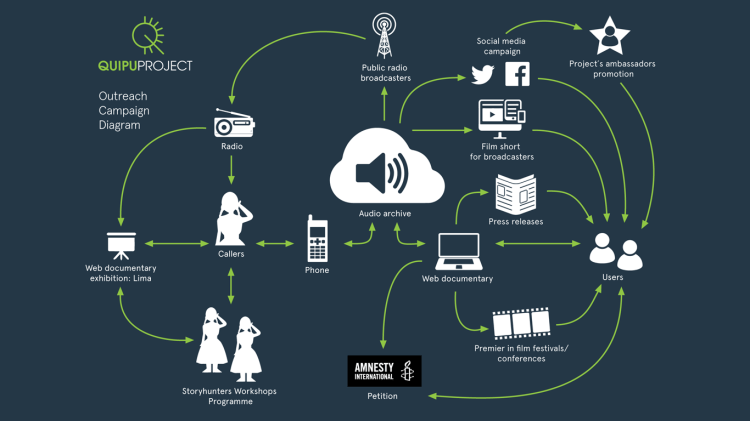
Secrets’ approach is taken up and evolved in The Quipu Project (2013), a semi-open hypertext/participative environment and ongoing databased collective memory archive intended to unearth Peru’s history of forced and targeted sterilization of nearly three hundred thousand indigent, indigenous women. It takes its name from ancient Andean and Incan practices of using elaborately knotted cords called quipus to convey messages and record histories. The interface reflects a contemporary interpretation of this rhizomatic storytelling system, compiling testimonies collected via a toll-free telephone number on its website, rendering them navigable and soliciting responses from listeners around the world in a bid to foster global dialogue and a communal demand for restorative social justice. Each testimony uploaded to the site is represented by a virtual thread, each response illustrated by a virtual knot, lacing together disparate elements into an endless, organic and nonlinear narrative that makes plain another kind of public secret.
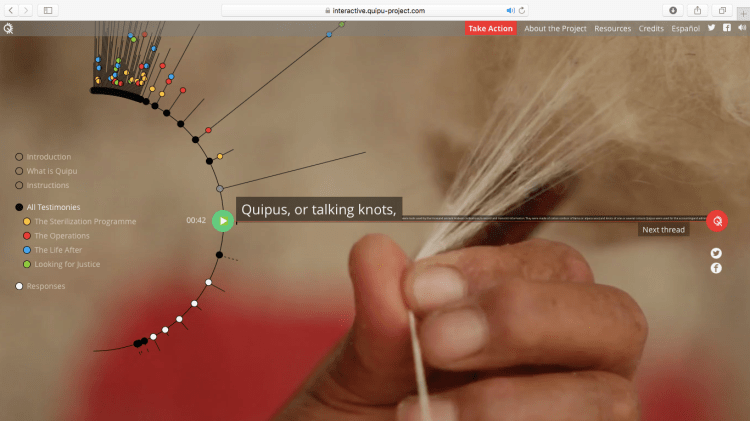
Quipu embodies what Gaudenzi (2013) labels a living documentary, based on and created by the dynamic relationships that form between user, author and code by way of a human-computer interface and its attendant ecosystem. By her logic, it is an adaptive and autopoietic assemblage of interdependent elements. It can likewise be regarded as an example of what de Michiel and Zimmerman call open space documentary, an approach to nonfiction narrative and adaptive storytelling in which producers become context providers and media “provoke curiosity about and compassion for the thinking of other people, to encourage reciprocal and open-ended collaborations” (2013, 353). And compassion begets empathy.
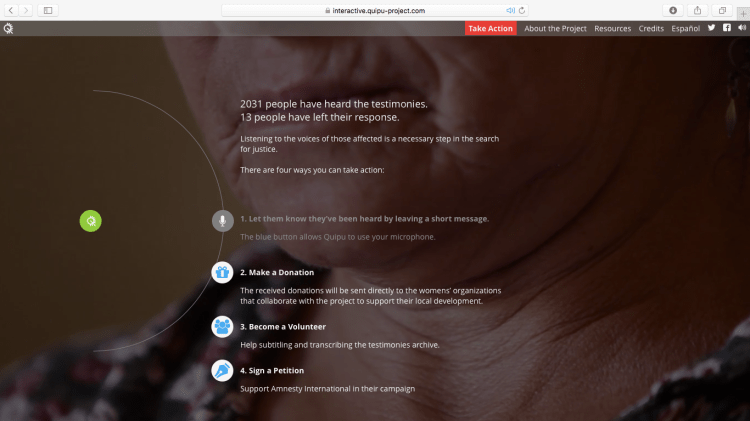
Of the works here discussed, Quipu provides the most concrete opportunity for postinteractive political action, undertaken in reality, in support of recognition and reparative justice. Clicking “take action” at any point in the viewser’s interaction truncates the experience and allows her to leave an audio response, donate to local women’s organizations, volunteer to subtitle and transcribe new testimonies submitted to the archive or sign an Amnesty International petition. The interactive, digitally mediated experience can thus yield an embodied, empathic, productive one.
I end here with Fearless (2014), an interactive, immersive, experiential documentary on sexual harassment and public safety for women in India. It promises, by way of a choose-your-own-adventure narrative, to show firsthand what it is like to navigate the streets of India as a woman. Bringing to mind virtual reality experiments (Gender Swap, The Machine to Be Another) that dispose of and efface gender by providing “men” with a “woman’s” view and vice versa, Fearless asks us, “What does it mean to be a woman? What is the change that we are looking for? What is safety?” If virtual reality is indeed “the ultimate empathy machine,” perhaps the experiential interactive documentary that allows us to see the world though another’s eyes, to “decide how to travel and who to talk to” (as in Fearless) is not far behind.

Works cited
Alma: A Tale of Violence. 2012. Miquel Dewever-Plana and Isabelle Fougère.
Aston, Judith and Sandra Gaudenzi. 2012. “Interactive documentary: setting the field.” Studies in Documentary Film, vol. 6, no. 2: 125–39.
Daniel, Sharon. 2012. “On politics and aesthetics: A case study of Public Secrets and Blood Sugar.” Studies in Documentary Film vol. 6, no 2: 215–27.
De Michiel, Helen and Patricia R. Zimmerman. 2013. “Documentary as an Open Space.” In The Documentary Film Book, edited by Brian Winston, 355–65. London: British Film Institute.
Fearless. 2014. Avni Nijhawan.
Gaudenzi, Sandra. 2013. “The Living Documentary: from representing reality to co-creating reality in digital interactive documentary.” PhD diss., Goldsmiths, University of London.
Gaudenzi, Sandra. 2014. “Strategies of Participation: The Who, What and When of Collaborative Documentaries.” In New Documentary Ecologies: Emerging Platforms, Practices and Discourses, edited by Kate Nash, Craig Hight and Catherine Summerhayes, 129–48. Basingstoke: Palgrave Macmillan.
Kinder, Marsha. 2003. “Designing a Database Cinema.” In Future Cinema: The Cinematic Imaginary after Film, edited by Jeffrey Shaw and Peter Weibel, 346–53. Cambridge: The MIT Press.
McMillan, Sally J. 2002. “Exploring Models of Interactivity from Multiple Research Traditions: Users, Documents and Systems.” In Handbook of New Media: Social Shaping and Consequences of ICTs, edited by Leah A. Lievrouw and Sonia Livingstone, 163–81. London: SAGE Publications.
Milk, Chris. 2015. “How virtual reality can create the ultimate empathy machine.” TED, March.
O’Neill, Kel. 2014. “NYFF Convergence: What’s to Be Gained with Interactive Storytelling?” Indiewire, September 25.
Public Secrets. 2008. Sharon Daniel with Erik Loyer.
The Quipu Project. 2013. Maria Court, Rosemarie Lerner and Sebastian Melo with Ewan Cass-Kavanagh.
1460 words
 Jasper Lauderdale